Rainbow Track Drift
par NAILUJ
Synthwave
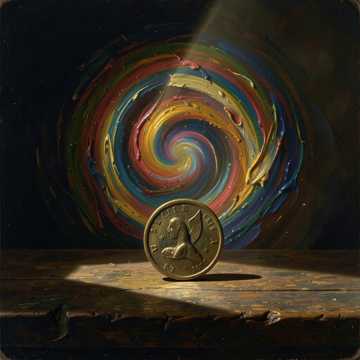
Écoute ce morceau sur la radio communautaire Tuneria.
Ouvrir sur Tuneria · Page de l'artiste · Album : INSERT COIN
par NAILUJ
Synthwave
Écoute ce morceau sur la radio communautaire Tuneria.
Ouvrir sur Tuneria · Page de l'artiste · Album : INSERT COIN
128 BPM. No vocals anywhere on this track. Bar 1: eight-bar arpeggio in A minor, saw lead, portamento on every fourth note — the rainbow motif, stated clean in the first seven seconds. Gated pad underneath, sidechained to a soft kick. A coin drops into the slot on the downbeat: metal, dry, no tail.
The arpeggio splits in two. Upper octave keeps the shape, lower octave drops notes three and six — the track breaking apart under the kart. Tom fills panned hard left to hard right, one per bar, a drift through each corner. Bass enters on sub-sine only, root notes, no movement. Under it all: CRT hum at 15.7 kHz, left channel, never resolved.
Sixteen bars of rise. Kick drops out at bar 9. White noise sweep opens from 200 Hz to 12 kHz, filter resonance climbing. The arpeggio pitches up a semitone every four bars — four lifts, no landing. Last two bars: silence, then a single ring tone, bright, spinning, sustained one full second.
Drop one. Full kick, 128, distorted saw stack on the motif at double speed. Snare on the upbeat only — the kart sliding wide. Octave bass doubling the lead. Eight bars, then a one-bar cut to dry kick alone, then eight more. Hats open on the final two bars.
Synthwave bridge. 112 BPM, tape-slowed. Gated reverb snare, long decay, nothing else dry. The arpeggio becomes a chord progression, played as whole notes on a soft Juno pad: Am — F — C — G, twice through. Analog bass walks the roots. Then: the pad tunes downward, pitch wheel bent flat, and every drum drops away. The motif falls alone, no floor under it. Four bars of nothing but the fall.
Drop two. Hits at 134 BPM, faster than drop one — no transition, straight in on the impact. Kick and clap together, motif inverted: the melody that climbed now descends through the same intervals. A block locks into place on each bar line, hard quantized. Sixteen bars. Lead doubles an octave up at bar 9.
Everything sheds. Lead first, then clap, then bass, then kick. Twenty bars of decay. The arpeggio returns at quarter speed, one note per bar, four notes only, A — C — E — A. Counter display ticks down behind it: three, two, one, zero. CRT hum holds four seconds past the last note, then cuts dead mid-cycle. Total: 6:12.